“Yours in Christ.” Would you sign your emails to friends, family and coworkers this way?
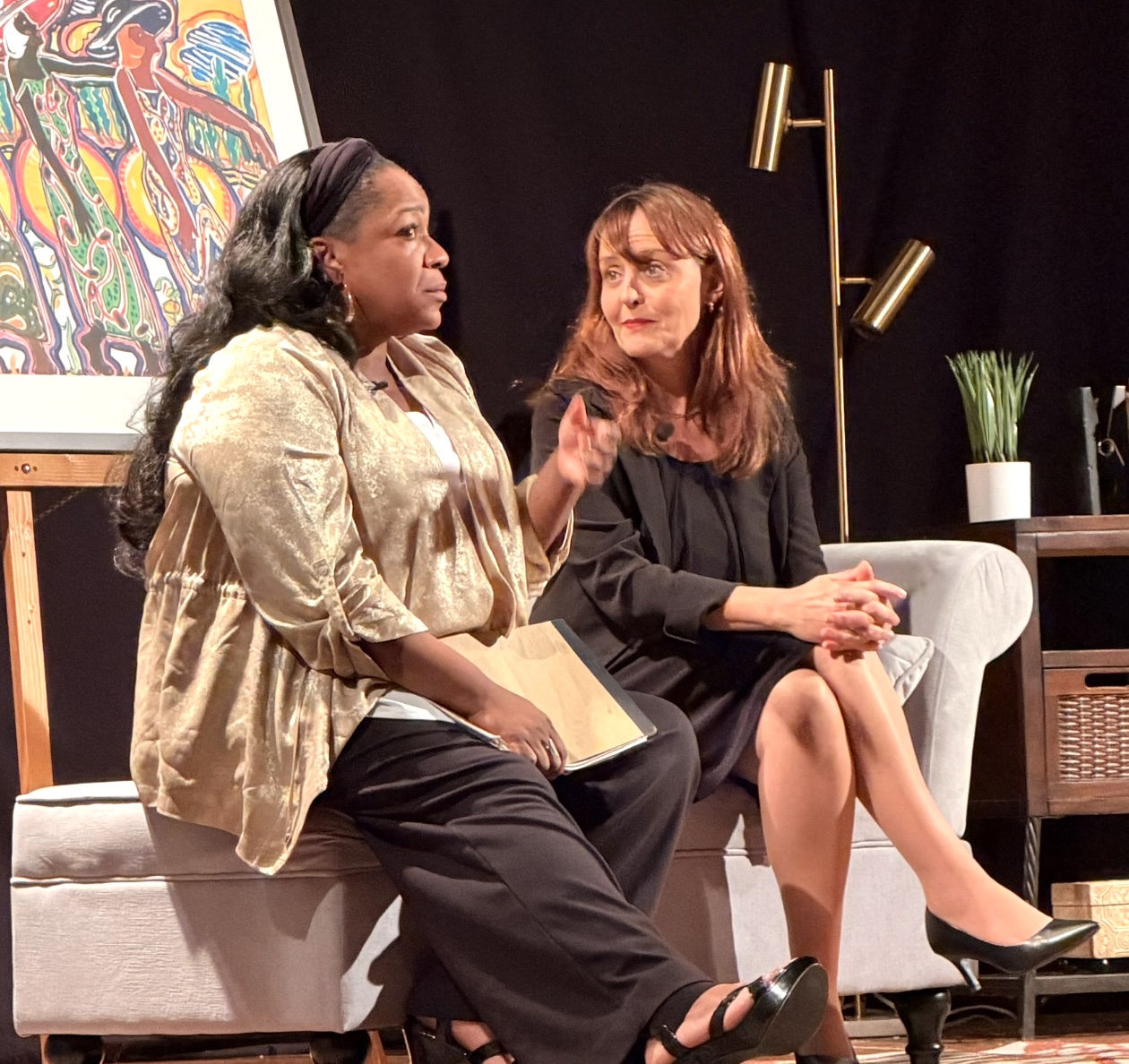
If your answer is “Sure, no problem!”, then you share the view of Gabriella in the short play The God I Know. I attended a performance at Fairmount Presbyterian Church with my wife in mid-November 2025 and exited the experience recommitted to the roots of my (Catholic) Christianity by striving to mirror Jesus’ compassion - even when dialoguing about hot-button topics.
Some of Gabriella’s coworkers who were Muslim, Jewish, not formally religious at all, not Christian or not her brand of Christianity, viewed the “Yours in Christ” signature as an attempt to proselytize. They told her that it also seemed to imply an exclusivism: “I am a proud member of my Christian denomination and chances are you are not.” Some also entertained the suspicion that Gabriella may be sympathetic to the surging White Christian Nationalist movement in America.
The playwright, Dr. Deborah Plummer, is a Cleveland-area psychologist and founding Executive Director of Getting to We, Inc., a nonprofit “that uses the transformative power of the arts to help people understand our core identity as humans and relate to each other without fear.” The God I Know was not afraid to encourage its audience to have meaningful conversations about religion in public spaces while also respecting religious liberty, freedom of speech, and separation of church and state.
The play explored the different notions of God that people hold. Some believe in a God who is exclusive or vindictive. Some have a “very small God” made only in their own image and likeness - as do White Christian Nationalists, who seek to establish Christianity as the law of the land to the exclusion of residents who are not Christian and not European in origin. To my mind, this disregards the fact that colonists arrived to escape persecution and to worship freely - and there is the uncomfortable fact that there were millions of indigenous people already here at the time of colonization who were not Christian.
The God I Know made me contemplate the fact that a “Christian nation” would not bring all Americans together. It would divide us even more. Many people, Christians included, are being drawn to extreme conservative movements such as Christian Nationalism because on the surface they seem to be providing certainty and easy answers at a time when the U.S. and the world at large are experiencing upheaval.
As a Catholic who mourns the fact that Jesus’ core message of love and inclusion is being ignored in harsh political rhetoric and disregarded by extremist political groups, I worry about how to move conversations toward understanding and compassion. How can we feel less helpless when we wish to pour our hearts out about religion, inclusivity and politics?
In the words of Dr. Plummer: “What’s needed to move forward is social trust – a belief that, despite our different faith traditions (or lack thereof), we share a core humanity. That we can speak honestly and listen openly. That we can hold space for one another without fear, judgment, or the need to convert or conform.”
What does this mean specifically? As a start, I recommend reading The God I Know: A Community Social Trust Project Resource Toolkit, from the organization that produced the dramatic production, The God I Know. It describes the history and current practice of Christian Nationalism, what the U.S. Constitution says about religion, and tips for having conversations on Christian Nationalism (my personal favorite).
The more you learn about Christian Nationalism, the more confidently you will be able to dialogue with others about the ways in which it differs from Jesus’ core message. As the publication (linked above) advises, these trust-building conversations are based on “a belief that our core identity is that of being human. The goal is human connection and relating to each other without fear. We do this by creating a container to hold multiple perspectives and remaining curious about someone else’s perspectives. This does not mean we can’t disagree … in fact, it means that we anticipate and expect to disagree.” (My emphasis.) - But we are working to truly understand each other, coming from a place of love.
*Suggested reading:
Rev. Dr. William J. Barber III, Our Moral Movement, Substack subscription.
John Fugelsang, (2025). Separation of Church and Hate: A Sane Person’s Guide to Taking Back the Bible from Fundamentalists, Fascists, and Flock-Fleecing Frauds, AvidReader Press, New York, NY.
Robert P. Jones, (2020). White Too Long. Simon & Schuster, New York, NY.
Valarie Kaur, (2020). See No Stranger: A Memoir and Manifesto of Revolutionary Love. Penguin Random House, New York, NY.