If you are able to go along on our church’s upcoming mission trip to Alabama, my advice is – don’t miss it. I toured the Civil Rights Trail in Alabama by myself in 2022, and found it to be an unforgettable experience.
A little bit about me: I belong to St. Dominic Church, I’m a member of its Racial Equity Task Force, and I love to travel. I’m a metallurgical engineer and in 2022 I happened to be in Alabama touring the old iron-making furnaces scattered around the state that date back to the 1800s.
While there, I decided to explore more of the state. I knew that Alabama had played a central role in the civil rights movement, and I wanted to see these historic spots up close.
So I drove to Montgomery, the city where Rosa Parks refused to give up her bus seat and got arrested. In an amazing act of self-determination, the black citizens organized the year-long Montgomery Bus Boycott. They walked or arranged carpools rather than continue to ride segregated city buses. The boycott lasted from Dec. 5, 1955 to Dec. 20, 1056, ending when a federal district court declaring segregated bus seating to be unconstitutional.
In Montgomery, I visited the Civil Rights Memorial Center. There are 41 names listed on the memorial, all identified as martyrs for civil rights. One is a name I remember from my childhood, Viola Liuzzo, a young white mother from Detroit who was killed for her part in the Selma march. I grew up in Detroit and my mom had told me about Viola, who had watched the TV coverage of the civil rights struggles and in 1965 felt called to go to the South to make a difference. While she was driving black protesters after a Selma march, a group of Klan members shot her dead.
At the memorial, there is a fountain with a quote from Dr. Martin Luther King Jr. - "Until Justice rolls down like Waters and Righteousness like a Mighty Stream". As I reached out to touch the water, I was reminded of so many things: The cleansing waters of baptism. The necessity of water for life. The force of water in floods and rivers. The way water changes landscapes, wears away rock, washes us clean.
Another important stop in Montgomery is The National Memorial for Peace and Justice. At this memorial, there are suspended metal boxes with names of people killed by lynching. Most of the boxes are for counties where lynchings took place, although there are some boxes for states. You are able to walk among the boxes and look up at the names. Row upon row of names. Many victims are listed as Anonymous, which broke my heart. I was stunned to see a box listing people lynched in Ohio. I had never thought that lynchings happened here. There are 15 names for Ohio and the last date is 1932. The place feels holy - surrounded by all of the names. As you leave the memorial, there is a second set of metal boxes. Rather than being suspended, these are laid out in rows - like coffins. All of the names bearing witness to what happened.
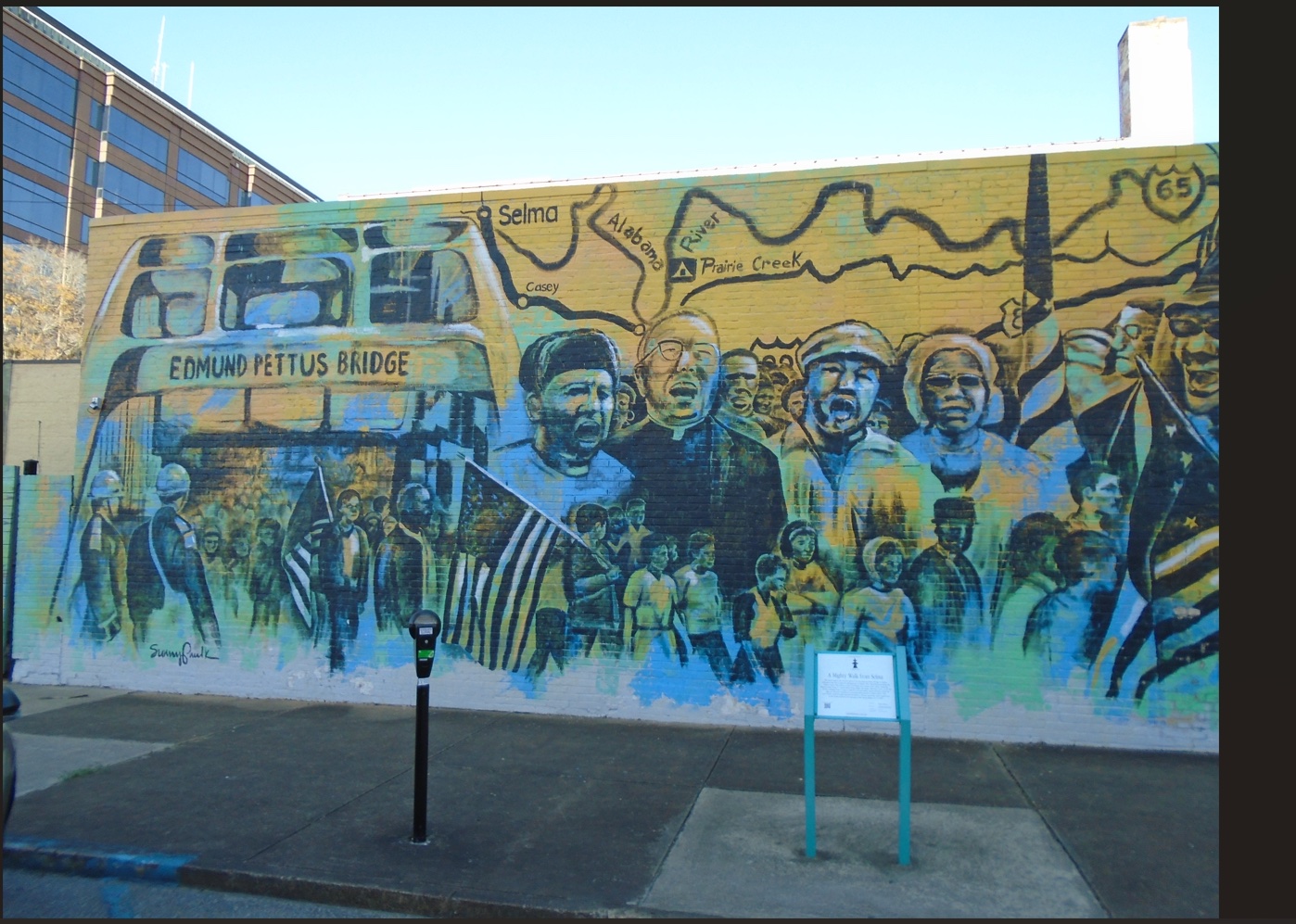
Getting back in the car, I headed for Selma. As I made the 55-mile trip there from Montgomery, I saw markers paying tribute to a historic 1965 march between the two cities. It had taken five days for the protesters to reach their destination. The land is flat and the markers along the road denote where people spent the night. There is not much to see along the drive, but I wondered how the marchers felt. Were they singing? Praying? Chanting? Ultimately I was awestruck by their bravery.
Approaching Selma from the south, I got my first glimpse of the historic Edmund Pettus Bridge. This bridge was the site of Bloody Sunday, an attack on peaceful marchers by police in March 1965. It is the main artery out of Selma and it took three tries before the people were able to cross the bridge to make the march to Montgomery. The bridge remains the main way to get into Selma. I drove across the bridge into town and parked my car. On foot, I returned to the bridge and walked across it solo. I was alone with my thoughts wondering how others, nearly 60 years earlier, felt as they walked. Did they know they were making history? Were they scared by the police on the other end of the bridge? There is a small historical marker on the bridge. You have to be walking in order to read it. Stopping in the middle of the bridge gave me a chance to be still. To soak up all of the things I had learned and to remember all of those who came before.
This is a pilgrimage I encourage everyone to take. We can’t allow ourselves to forget these horrible events that took place in our nation’s past. And it wasn’t just in the South; these sins of violent racism happened all over our country. We have to educate ourselves on the past, or it happens again.
The parish trip to Alabama, coordinated by the Catholic Mobilizing Network, is scheduled for April 29-May 1, 2026. Participants will have guided tours of these sites and several more. For more information, contact Gaile Ozanne, gozanne@stdominicchurch.net, 216.991.1444.